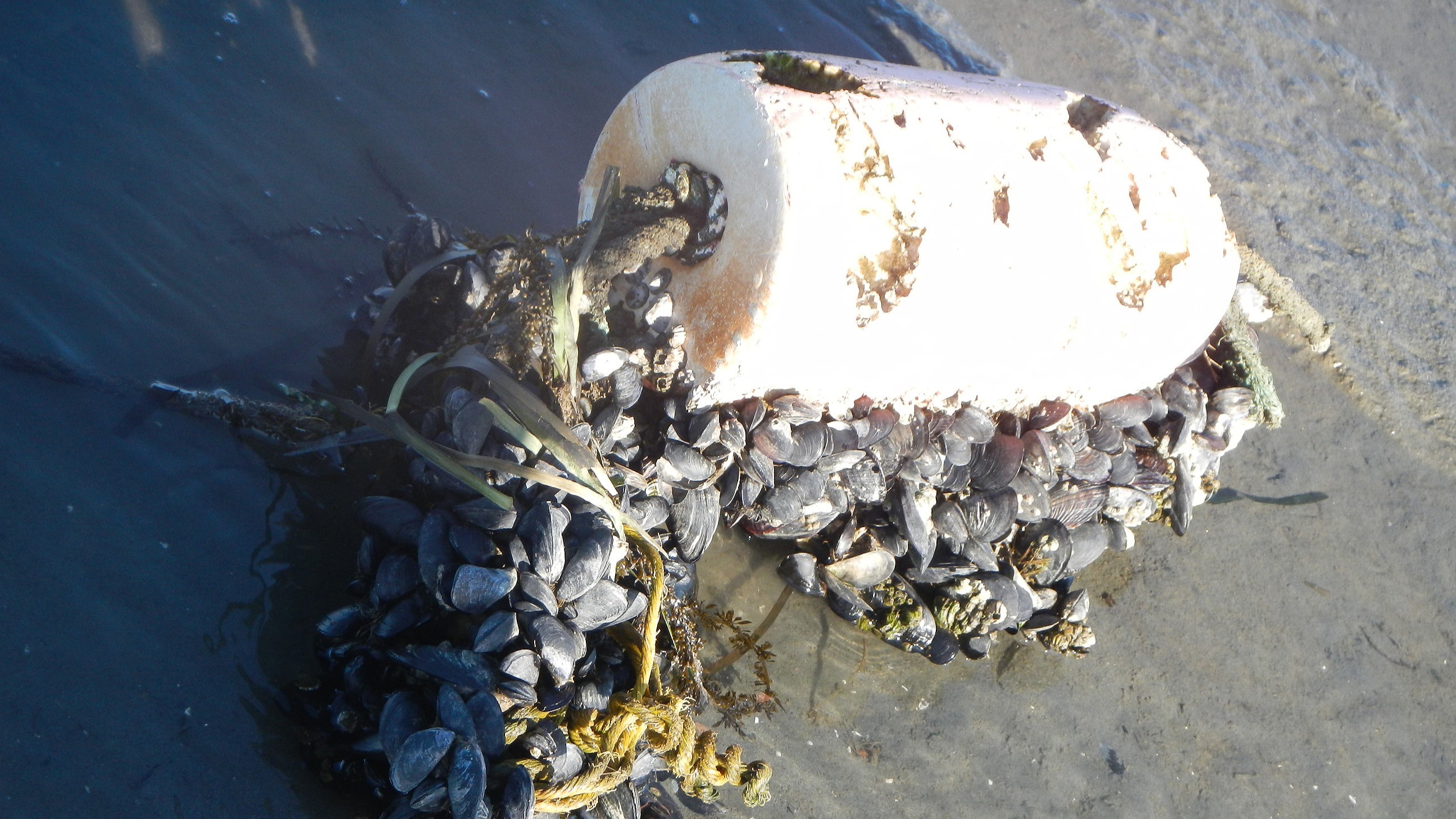
Anyone who has taken a walk along a beautiful BC shoreline has undoubtedly come across little white foam pieces tangled amongst the dried kelp and pieces of driftwood. It is a pervasive form of pollution that can harm wildlife, ecosystems and human health. Though there have been successful cleanup operations, these are expensive and can never keep up with the problem – so stopping the pollution at the source will always be the best option.
This foam is usually made of compounds called styrene, extruded or expanded polystyrene (commonly known as “Styrofoam”), which are plastic polymers with insulating or floatation properties. Foam in the ocean and on the shore originates primarily from floating marine infrastructure, including docks, recreational and commercial marinas and aquaculture operations.
Jurisdiction over marine infrastructure is divided and shared in many respects between the federal and provincial governments (subject to the title and rights of Indigenous nations). The federal government has jurisdiction to regulate aquaculture, and has indeed already prohibited the use of unencased foam in shellfish aquaculture operations. But because the Province has Crown title to large sections of the seabed, an individual or business hoping to build a dock or marina must seek permission from the Province. As a result, the Province has significant authority to regulate how these are constructed.
The BC Coastal Marine Strategy’s commitment to prevent polystyrene pollution
The provincial government released its long-awaited BC Coastal Marine Strategy in 2024. It includes a broad range of activities related to coastal management and stewardship, and one focus area is preventing marine pollution. It specifically includes a commitment to “[p]rohibit the use of polystyrene in future marine infrastructure construction.”
There are two approaches that we recommend the Province take to achieve this commitment, outlined below: one requires changes to policies under the Land Act, and one requires a new regulation under the Environmental Management Act.
Unencapsulated vs. encased foam
First, a note on unencapsulated vs. encased foam: some jurisdictions have sought to address foam pollution by requiring that marine infrastructure use encased foam (for example, foam wrapped in a thick flexible plastic sheet). However, the encasing risks being damaged, cracked or degraded in harsh marine environments, and then the encased foam brings with it the same issues as unencased.
This is why experts have advocated for non-foam floatation materials to be used instead. These include air-filled plastic and metal floats. And many of these non-foam alternatives are produced in British Columbia, so supporting these can boost the local economy.
Approach #1: Amend the Land Act policies that apply to marine infrastructure
The Province administers the use of Crown land in BC, which includes the seabed, pursuant to the Land Act. There are a number of land use policies under the Act, including one for private moorages, like docks, boat ramps or boat lifts. The Private Moorage Land Use Operational Policy exempts certain moorage facilities (including docks) from requiring a permit in some areas of the province, if a person meets a list of conditions. This is referred to as a “General Permission.”
In other areas of the province, where the General Permission does not apply, a person must apply for a “Specific Permission.” These areas are referred to as “application only areas.” A Specific Permission is also required for stand-alone boat lifts, a permanent way, a boat ramp, or a group moorage, no matter where they are located.
The Province should amend its land use operational policies under the Land Act to no longer allow foam in marine infrastructure, for both General and Specific Permissions, and include provisions to allow owners a reasonable amount of time to transition away from these materials.
The Sechelt example
In the Sechelt area, which is an application only area, BC has co-created with the Shíshálh First Nation a dock management plan. The shíshálh swiya Dock Management Plan prohibits the use of unencapsulated foam to keep docks afloat for new construction and repairs. Pursuant to the Plan, owners are required to register their existing docks and boathouses, and the Province’s authorization for the docks and boathouses under the Land Act will be transitioned to long-term 20-year renewable authorizations upon individual review.
BC and shíshálh planned to take three years to review individual docks and boathouses starting in 2024. In the interim, owners were given a General Permission for the existing structures as built, subject to upgrade requirements. The upgrade requirements gave owners 10 years to replace any unencapsulated foam. However, if a derelict structure was identified (for example, docks where the foam was actively breaking apart), the owner was required to provide a remediation plan that would be completed within two years.
The Province could use the shíshálh swiya Dock Management Plan (which currently only applies to Sechelt) as a model for the whole province, while also prohibiting encased foam due to the risk of damage to its casing. It should also amend its land use operational policies for other marine infrastructure, including floating home communities, marinas, aquaculture operations, adventure tourism (commercial recreation) operations, and ocean energy operations.
Approach #2: Enact a regulation under the Environmental Management Act
The Environmental Management Act is the main provincial statute that regulates “industrial, commercial and municipal waste discharges, pollution, hazardous waste and contaminated site remediation in BC.” Previously, the Province has created regulations under the Act to prohibit the distribution or sale of a number of single-use plastic items, to prohibit the sale of certain types of antifreeze, and to limit who may purchase and possess ozone depleting substances, among others.
The Province should enact a regulation under the Environmental Management Act that prohibits the sale and construction of foam marine infrastructure. This would slowly phase out foam in marine infrastructure by targeting distributors, retailers and contractors – while supporting the BC-based businesses that manufacture air-filled flotation.
The Ontario example
This approach has been adopted in Ontario. The Keeping Polystyrene Out of Ontario's Lakes and Rivers Act, requires those who sell docks, buoys or floating platforms to ensure that any extended polystyrene (EPS) or extruded polystyrene (XPS) is encapsulated; and that a person who constructs or reconstructs a dock that uses EPS or XPS ensures it is encapsulated.
Because there are limitations to each approach, proceeding with both is best
We have outlined two complementary approaches British Columbia could adopt to address foam pollution from marine infrastructure. Ideally, both approaches would be adopted.
However, each has its own limitations: the approach of prohibiting the sale and construction of foam infrastructure under an Environmental Management Act regulation would not address existing foam marine infrastructure, while it is possible that the Land Act approach may not apply to some existing foam marine infrastructure (for example, that which is subject to very long-term leases). This might mean that existing degrading foam infrastructure could continue to pollute for years.
Thus, we strongly recommend that these approaches be supported by a provision in the Environmental Management Act regulation prohibiting allowing foam infrastructure to degrade into water, and a phased-in prohibition on the use of foam in marine infrastructure altogether – all on an ambitious timeline that reflects the severity of this issue.
No one wants to see our beaches littered with foam. It is time that we cut this problem at its source.
Top photo: National Park Service (Public Domain)