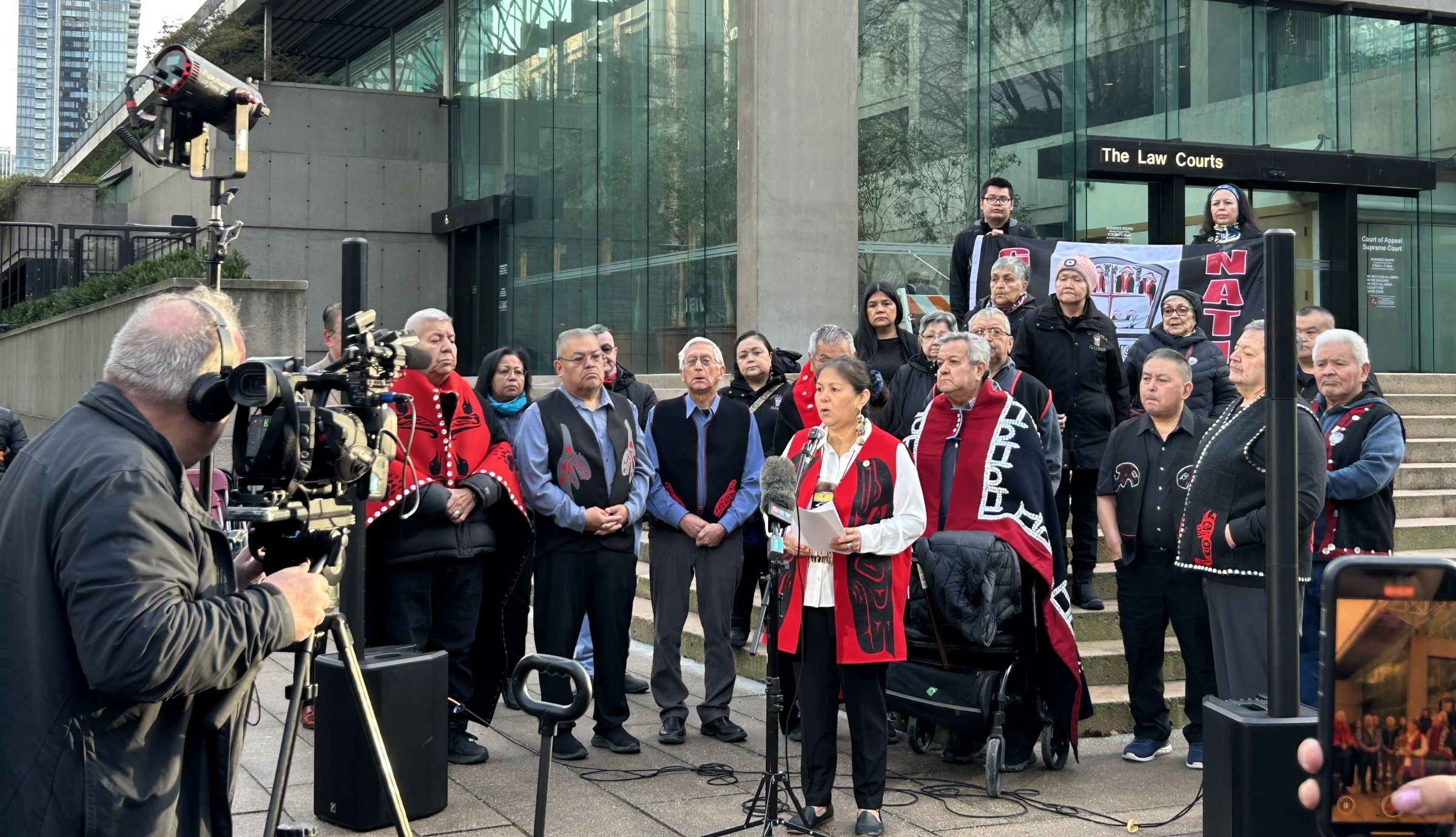
On December 5th, 2025 the BC Court of Appeal released its judgment in Gitxaała v. British Columbia (Chief Gold Commissioner) – affirming that BC’s Declaration on the Rights of Indigenous Peoples Act (Declaration Act) is legally enforceable.
This precedent-setting decision found that BC has a legal duty to cooperate with First Nations to align its laws with the UN Declaration on the Rights of Indigenous Peoples (UN Declaration). It also held that BC’s outdated mineral claim regime is inconsistent with the UN Declaration.
So, what does this mean for Indigenous rights, provincial laws and decisions about resource development in BC?
Shortly after the decision, West Coast Environmental Law hosted a webinar with legal counsel for Gitxaała Nation and Ehattesaht First Nation and many of the intervenors in the case to discuss the court decision and potential implications going forward. You can review a recording of the webinar on YouTube or Vimeo (without ads).
Now, we’re continuing the conversation with a series of Q&A blog posts delving into key questions about the case, the decision and what comes next.
Common questions about the Gitxaała v. British Columbia case and its impact
Q: What was the Gitxaała case about?
A: In this case, Gitxaała and Ehattesaht challenged BC’s mineral claim regime, which allowed mineral rights to be acquired in First Nations’ territories automatically online with small payment ($1.75 a hectare) without consultation, consent or even notification of impacted Nations.
Gitxaała and Ehattesaht argued that this system violated the provincial government’s constitutional duty to consult and was inconsistent with the UN Declaration. The case was the first to rule on whether the commitments made in BC’s Declaration on the Rights of Indigenous Peoples Act (Declaration Act) could be enforced in court.
Q: What are the UN Declaration and Declaration Act, and why were they enacted?
A: The UN Declaration was adopted by the United Nations General Assembly in 2007 and endorsed by Canada in 2016. The rights recognized in it are considered “the minimum standards for the survival, dignity and well-being of the indigenous peoples of the world” (Article 43), e.g., rights to culture, identify, self-determination and land. Article 32(2) of the UN Declaration says governments must consult and cooperate with Indigenous peoples to obtain their free, prior, and informed consent before approving resource projects.
In 2019 BC passed a law affirming that the UN Declaration applies to the laws of BC and Canada followed suit in 2021. BC’s Declaration Act was passed unanimously by all political parties in the Legislature, with the support of industry, business and labour.
The BC and Canadian governments passed UN Declaration laws to advance reconciliation, which includes repairing and improving government and settler relationships.
Q: What happened in the BC Supreme Court?
A: In September 2023, the BC Supreme Court (the lower court) declared that BC’s system of allowing automatic registration of mineral claims breached the Crown’s constitutional duty to consult and gave BC 18 months to reform its regime.
However, the lower court ruled that section 3 of BC’s Declaration Act – which says the government “must take all measures necessary” to align BC laws with the UN Declaration when there is an inconsistency – was “not justiciable,” meaning First Nations could not ask a court to hold BC accountable for this commitment.
Q: What did the BC Court of Appeal decide about the Declaration Act?
A: The December 2025 decision in Gitxaała Nation v. British Columbia (Chief Gold Commissioner) marks a turning point. The BC Court of Appeal (BCCA, the higher court) confirmed that aligning provincial laws with the UN Declaration is a legal obligation, not just a political aspiration, ruling that:
- First, all BC laws must be interpreted consistently with the UN Declaration, if possible. This includes the common law duty to consult.
- Second, courts do have jurisdiction to decide if a law is inconsistent with the UN Declaration. When there is an inconsistency, government must consult and cooperate with Indigenous peoples to bring the law into alignment.
Q: What does the Gitxaała decision mean for decision-making about resource development in BC?
A: The constitutional duty to consult arises any time Crown conduct may impact First Nations Title and Rights. The Gitxaała BCCA decision means at least two important things for meeting this duty:
- First, a First Nation may raise UN Declaration rights in consultation, such as the right to the conservation and protection of the environment (Article 29(1)), or the right to determine and develop priorities and strategies for the development of their territories (Article 32(1)).
- Second, the general rule is that First Nations’ consent is required prior to granting resource rights (tenures) or resource development approvals. This applies not only to mineral rights and mining, but other resource industries such as forestry or oil and gas.
In addition, based on the reasoning in the Gitxaała decision, Crown governments may not unilaterally amend legislation that affects Indigenous Peoples without consulting and cooperating to ensure UN Declaration consistency. This would, for example, restrict efforts to lift or weaken the Oil Tanker Moratorium Act to build a north coast bitumen pipeline project if coastal First Nations do not consent.
Q: What does the Gitxaała decision mean for the Mineral Tenure Act and BC’s mineral claim regime?
A: The BC Court of Appeal agreed with the appellants that there was an “obvious” inconsistency between BC’s mineral claim regime and the UN Declaration.
The Court’s decision means that Nations can hold the government accountable in court if BC fails to consult and cooperate with them in reforming its mineral claim regime or fails to ensure a new regime is consistent with international human rights standards set out in the UN Declaration. This creates an important legal “backstop” – ensuring that if government reform stalls or if a proposed new regime fails short, Indigenous peoples may ask courts to review government conduct and provide guidance.
Q: What is the current status of mineral tenure reform in BC?
A: Despite long-standing calls from First Nations, local governments, private landowners and civil society groups to reform BC’s gold-rush era “free entry” system, it was only after Gitxaała filed their mineral tenure case that BC agreed, in the 2022 DRIPA Action Plan, to cooperate with Nations to modernize the Mineral Tenure Act. Almost four years later, little progress has been made.
After the BC Supreme Court decision in 2023, rather than getting down to the business of cooperating with Nations to overhaul the Mineral Tenure Act to align with the UN Declaration, BC instead unilaterally developed and imposed a very minimal “Mineral Claims Consultation Framework” (MCCF). It only provides:
- monthly, “batch” notifications of mineral claim applications in a Nation’s territory;
- a tight 30-day window for Nations to respond; and
- a further 30-60 days for BC to decide whether to accommodate the Nations’ concerns.
The MCCF falls short of meeting the Crown’s constitutional duties and is not consistent with the UN Declaration. It offers a low level of consultation that fails to take into account the serious impacts from mineral claim registration found by the courts and does not provide for free, prior and informed consent.
Q: What might real reform to the mineral tenure regime look like?
A: First Nations leadership across BC have articulated what meaningful, UN Declaration-aligned reform would require. Through resolutions of the Union of BC Indian Chiefs and the First Nations Summit, Nations have described what it would look like to replace free entry with consent-based, cooperative decision-making, stating that:
[A]lignment of legislation replacing the MTA with the UN Declaration must achieve the following outcomes:
- end the legislated presumption that virtually all lands in B.C. outside of protected areas are open for mineral claim staking regardless of their other cultural, ecological, or economic values,
- modernize default legislative restrictions on where mineral claim-staking can/cannot occur in cooperation with First Nations (e.g., community watersheds, fisheries sensitive watersheds, Indigenous Protected and Conserved Areas (“IPCAs”)),
- First Nations determine, at a strategic level if desired, which areas of their territories are potentially open to mineral claims, through mechanisms such as First Nations-led land use planning, consent-based or joint decision-making agreements, and/or designating “no-go” areas for mineral claims, using new or existing legal tools,
- provide that existing mineral tenures granted without free, prior, and informed consent may be revoked by impacted First Nations,
- legislatively limit compensation payable by the Province to claim-holders to reduce barriers for implementing First Nations’ land use plans, IPCAs etc.,
- free, prior, and informed consent is a requirement at every stage of the mining life cycle and the practice of granting mineral claims and mining leases without First Nations free, prior, and informed consent is ended,
- remove legal barriers and create legal space for First Nations to develop and operate their own mineral tenure granting systems according to their own laws, legal orders, systems of governance, and jurisdictions if desired,
- replace or abolish the “free miner certificate”,
- limit or make conditional the rights granted with a mineral claim,
- legally ensure full financial resourcing for Indigenous governing bodies to carry out decision-making in relation to the above, and
- provide for appropriate public consultation and civil society involvement.
These reforms must be co-developed with First Nations titleholders and informed by consultation with communities, private landowners, NGOs, industry and others.
Until that happens, the Court of Appeal has made clear that government must exercise powers under the current mineral tenure regime in a way that is UN Declaration-compliant. The most defensible way to do so is simple: register mineral claims only where affected First Nations have consented.
Top photo: Gitxaala Nation representatives at the courthouse during Court of Appeal hearings in Jan. 2025 (Photo: Alexis Stoymenoff)