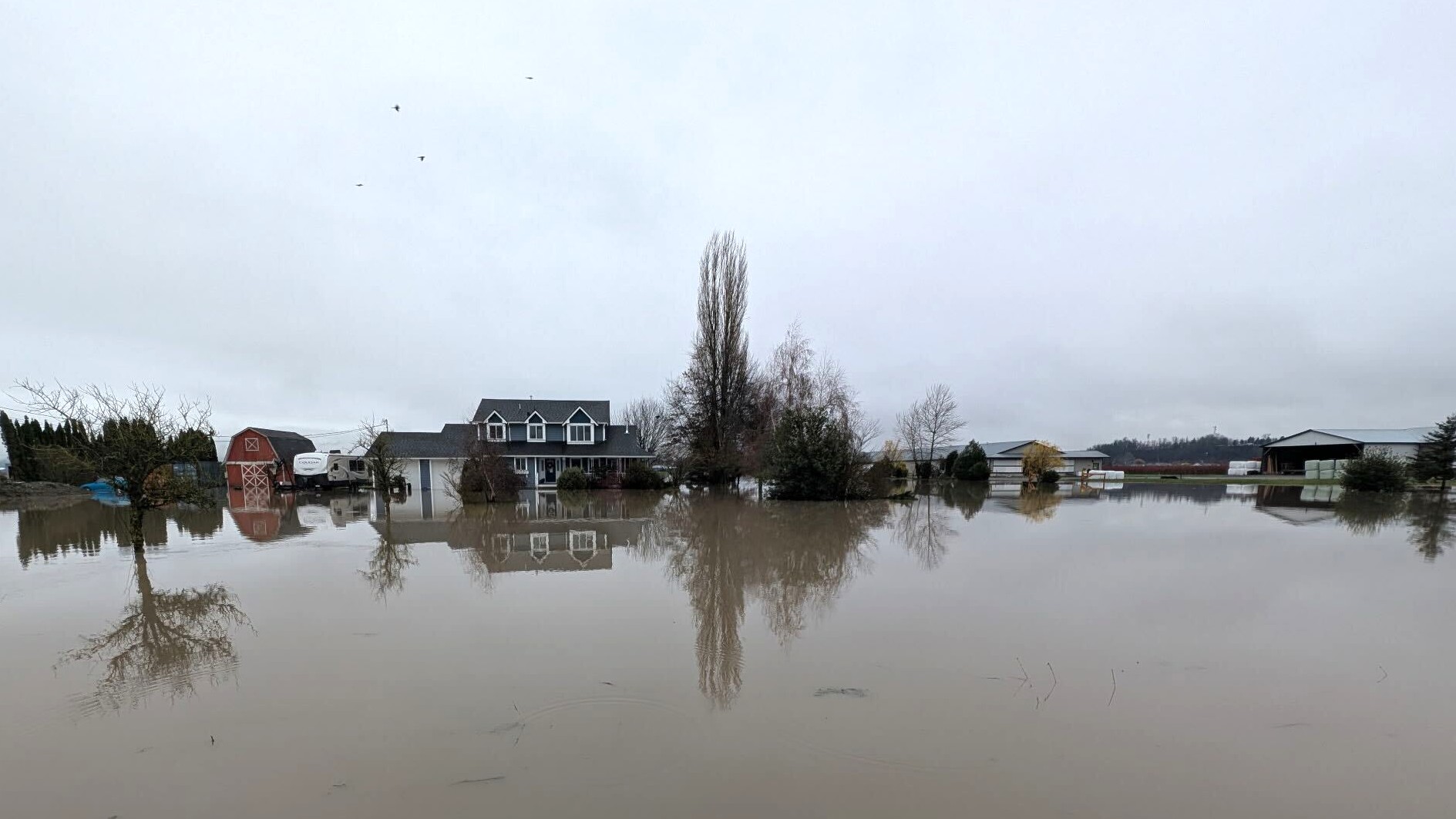
In our current mind-rending news cycle, images of climate chaos are becoming so familiar that we barely register their catastrophic losses anymore. But the flooding that recently returned to British Columbia’s south coast, four years after the destructive atmospheric river events of November 2021, serve as a local chapter in a global anthology of climate-driven floods that marked the latter half of 2025.
Little attention has been paid to the rising death toll caused by climate-driven floods in both developed countries and in the Global South. From the heavy rains that flooded displacement camps in Gaza in December; to the devastation wrought by Cyclone Ditwah in Sri Lanka that took over 600 lives; to the intense rains and flooding that hit Texas in July, killing at least 120 people – these stories flash so quickly across our screens that we may be failing to make the distinct connection to their root causes.
There is, of course, a sense of bitter gratitude that the latest floods in BC caused less damage to major infrastructure and to communities than the 2021 floods, which were, after all, the costliest natural disaster in British Columbia's history. However, for those living on the Sumas Prairie – who feared that their homes might again be submerged as the Nooksack and Sumas rivers sought to re-visit the former Sumas Lake bed – there are important questions that demand answers: Why is this happening again? How are we still unprepared? Why are we making it worse?
Unimplemented and underfunded: what’s happening with BC’s Flood Strategy?
Flood disasters in BC, from Grand Forks to the Nicola Valley, produce a familiar cycle of shock, scrambled recovery and promises to do better next time. The provincial government, under intense scrutiny after the exposure of multiple and devastating deficiencies in flood management in 2021, slowpedalled the release of its BC Flood Strategy. When it finally arrived, the document brimmed with appealing language for regional planners, governance wonks, ecosystems scientists, municipal decision-makers, First Nations, fishers and farmers who were hopeful about an official document that reflected their concerns and recommendations.
The BC Flood Strategy offers a progressive vision: a co-governed, watershed-scale framework grounded in understanding flood risk, and proactive steps to reduce risk and build long-term resilience in coordinated and integrated ways that include nature-based solutions. With increased funding for nature-based projects like coastal wetland restoration and river reconnection in recent years, there is growing understanding of their benefits for flood regulation, as well as capacity to design and implement the work in BC.
Importantly, the Strategy aligns with the UN’s Sendai Framework for Disaster Risk Reduction (The Sendai Framework) and its focus on managing human exposure and vulnerability rather than pursuing the impossible goal of eliminating natural hazards. It also aligns with the UN Declaration on the Rights of Indigenous Peoples (UNDRIP), and its implementation through BC’s Declaration Act, and recognizes the importance of clarifying roles and responsibilities of provincial, First Nations and local authorities in land use planning and integrated management.
However, the Flood Strategy lacks funding needed for its implementation, and its transformative potential is unrealized.
Instead, the status quo remains in place: local governments and First Nations communities grapple with climate change, development pressures and increasing flood risks. They each shoulder the responsibility for keeping their communities safe, and also by default often protect regional infrastructure, relying on constrained budgets and occasional, unpredictable and usually inadequate grants from federal and provincial governments.
Dikes, dispossession and dysfunction: the colonial roots of Lower Fraser flood control
Flood management in the Lower Fraser River floodplain is rooted in colonial practices of settlement, development and dispossession of First Nations and attempts to control flood hazard by controlling the river and the sea. For over a century, diking and draining has been deployed to keep water out of the floodplain.
More than 600 kilometres of dikes are in the Lower Fraser, and it is no accident that some First Nations reserve lands are to this day located on the water side of those dikes. At present, dikes in BC are managed segment-by-segment by local diking authorities that are usually local governments. Provincial engagement in overseeing dikes has ebbed and flowed over the past century, but since 2003 the Province has legally restricted itself to inspecting existing dikes and approving new ones, as well as leaving decisions about development in the floodplain to local governments. With major floods having been infrequent, the dikes in the Lower Fraser have rarely been tested to their limits.
Given the well-documented shortfall in funding for all types of municipal infrastructure (the ‘infrastructure deficit’) across Canada, it’s perhaps not surprising that a provincially-commissioned study found that as of 2015 87% of Lower Fraser dikes weren’t up to current standards (not to mention their ability to withstand climate change impacts). And it was surely not news to local government diking authorities that repairing and upgrading them all was likely to be “prohibitively expensive.”
Further studies of seismic vulnerability simply confirmed another significant source of dike failure. The existing flood control infrastructure is also responsible for disconnecting more than 1700 kilometres of waterways in the Lower Fraser floodplain, with profoundly negative impacts on salmon and other species in what were once thriving and richly biodiverse ecosystems.
Historically, the federal government has backstopped a large portion of the recovery costs of major flood events when they do occur. Yet the true costs of flooding are not recovered, with survivors experiencing mental health crises, displacement, dwindling agricultural or business revenue, and recovery funds based on rigid requirements. The result is a predictable escalation of both physical vulnerability and financial liability, compounding losses for flood-prone communities while shifting an ever-growing burden onto taxpayers.
Other floodplain communities around the world have faced similar challenges waging battles with rivers, and falling short. There is now a well-established and tested body of practice of doing things differently: more holistic and affordable approaches that work with nature, weaving conventional flood control infrastructure with land use planning and regulation, and specific nature-based measures. British Columbia lags behind, but the BC Flood Strategy provides a roadmap for applying these practices here.
Yet the work can’t happen without regional/watershed planning and risk assessment, and coordinated implementation, supported by sustained investment in resilience. No single community can do this work alone.
On the other hand, communities and governments working together definitely can. The limitations are not practical, or technical, but political. We can choose to wait for the next atmospheric river event (there have now been three in the last four years) – rolling the dice on the safety of our communities, the stability and reputation of our major Pacific trade corridors, and the health of our unique and precious ecosystems. Or we can be proactive and make investments in multi-beneficial flood management and reap the rewards of building long-term resilience.
There is some urgency to move forward before risks become reality. The federal government has signalled its shift away from supporting cyclical and reactive disaster recovery, with new (April 2025) guidelines for federal Disaster Financial Assistance Arrangements that require evidence of ‘appropriate mitigation’ before future pay-outs will be made. Insurers are also giving notice that eligibility for coverage is linked to flood risk reduction and mitigation.
The federal Major Projects Office has been running ads touting a ‘strong’ Canada. However, projects that tie us to the industries worsening the climate crisis mean that in effect, we are left trying to bail out a bathtub with teaspoons with one hand, while rushing to open the tap with the other.
Resilience is strength. Investing in flood resilience in regions like the Lower Fraser in accordance with the BC Flood Strategy is a recipe for security, competitiveness, reconciliation and opportunity. Instead of another pipeline tying us to an industry that looks backward, we can invest in a pipeline of resilience projects and a legacy of multiple benefits for future generations.
Top photo: Flooding in Abbotsford, BC in December 2025 (Dan Pierce)