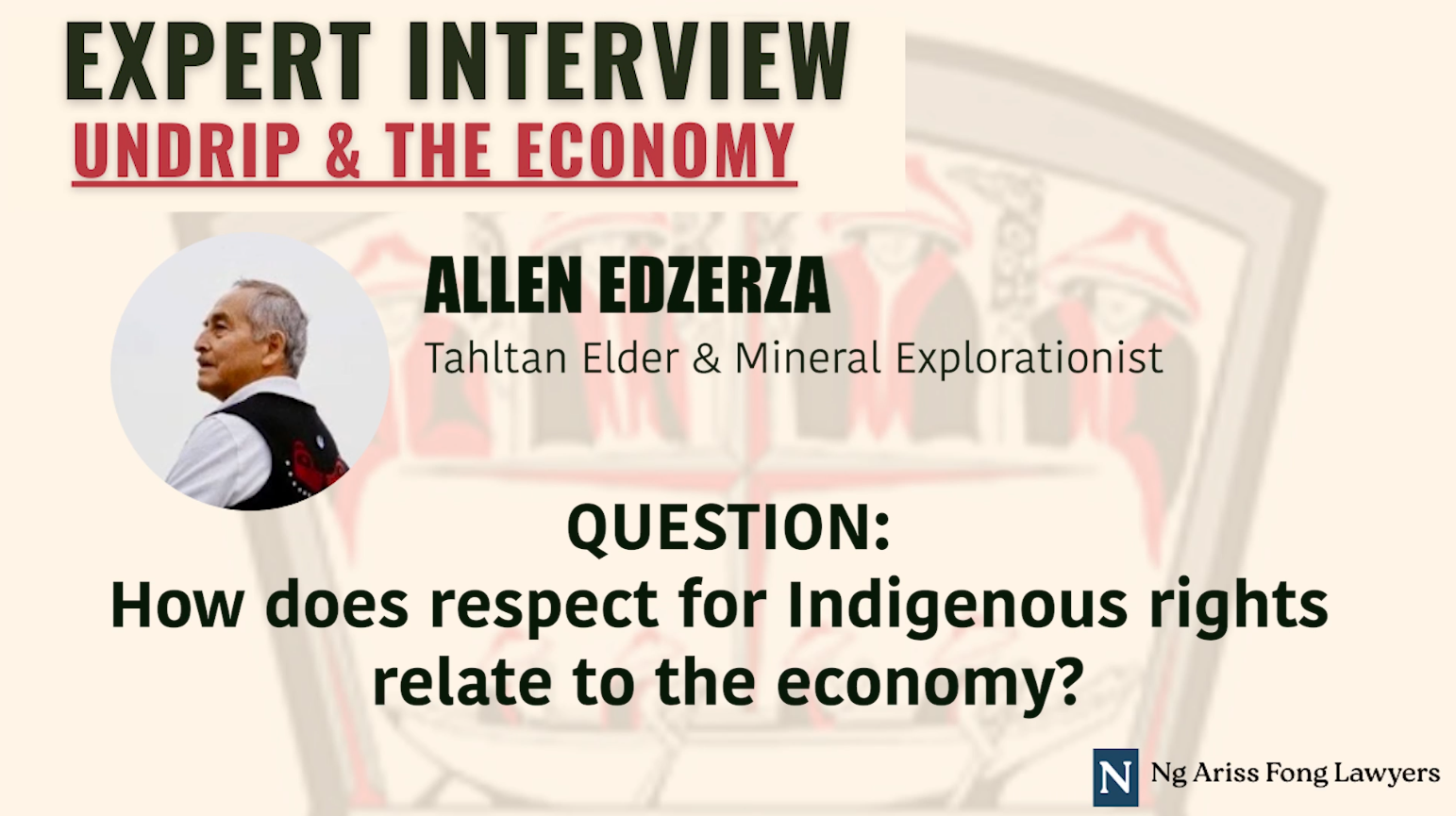
This blog series co-published by Ng Ariss Fong, Lawyers and West Coast Environmental Law features interviews with leaders and experts discussing the UN Declaration on the Rights of Indigenous Peoples (UNDRIP) and its relationship to the economy in BC and Canada.
Economic certainty depends on Indigenous rights
Following the BC Court of Appeal decision in Gitxaała v. British Columbia (Chief Gold Commissioner) – which affirmed the legal enforceability of BC’s Declaration on the Rights of Indigenous Peoples Act (Declaration Act) – we’ve seen a lot of commentary online and in the media about what this decision means for the economy.
While some argue that implementing UNDRIP and the Declaration Act creates regulatory uncertainty and delays, our experience shows that in fact, respecting Indigenous rights can lead to more certainty, less conflict and legal risk, stronger partnerships and collaboration, and long-term economic stability.
Lawyer Ruben Tillman (Ng Ariss Fong, Lawyers) discussed this with Tahltan Elder and Mineral Explorationist, Ma-Lah Allen Edzerza, who spoke about how respect for Indigenous rights is the foundation for successful projects.
Key takeaways:
- Building trusting, respectful relationships with First Nations creates the certainty companies need to finance projects and move them forward.
- Saying Indigenous rights are creating “uncertainty” relies on false narratives.
- Businesses benefit from clear expectations, which come from understanding how to respect the rights of the peoples on whose territories they operate.
Watch the video (transcript below):
Q: How does respect for Indigenous rights relate to the economy?
A: It’s no secret that it’s Skeena Resources that is working with us [Tahltan]. They would say it’s absolutely essential to have Indigenous support for the project, just to create certainty so that they can actually go out into the capital market and raise the financing.
Other mines that are ... mining companies, as you know, we have Newmont, Teck, Coeur’s, all in our territory, and they would tell you the same thing – that they will not move projects forward without the consent of the Tahltan. And so this idea that the Indigenous community is causing uncertainty is, in my view, far from the truth.
Q: What is causing uncertainty, if anything?
A: I think what’s causing uncertainty is that there’s a certain group that are making comments – legal people are making comments like “Aboriginal title and fee simple can’t coexist.” They’re saying that the province has given a veto to the First Nation people of British Columbia. And they’re stating all this stuff from a negative perspective for a purpose – to create that uncertainty.
If you want certainty, you’ve got to start talking about, “How can we work together?” and “What are the things that are needed to give so that the citizens of British Columbia have a clear understanding of what’s expected of them as citizens as they go to do resource development in First Nation territories?”
Even if you amend or repeal the [Declaration Act] legislation, Canada has endorsed and accepted the UN Declaration without prejudice. So it is, I think, across this country, I would expect it’s the federal law.
On how mineral exploration work can respect UNDRIP rights:
I think it’s all about first, respect for the people whose territory you’re going into. And then I think it’s about relationship-building, based off that respect. It’s got to be a trusting relationship. If I say I’m going to do something, make sure I do it. And I think that’s advice I’d give to any mining company or resource company that wants to go into our territory.
The economic opportunities of the province, especially in the resource sector, are not in Vancouver. It’s in the North, and when you take a look at our territory, Tahltan territory, it’s rich in minerals, it’s potential oil and gas, it’s got high potential geothermal, clean energy, and it’s my personal view that it is the economic future of the province. And I don’t think any of that can be developed in a successful way without full involvement and support of the Tahltan Nation. And I suspect that same kind of statement is true throughout the province, where there is resource development occurring.
Stay tuned for our next blog featuring insights from Gitxaała Nation Chief Councillor Linda Innes.