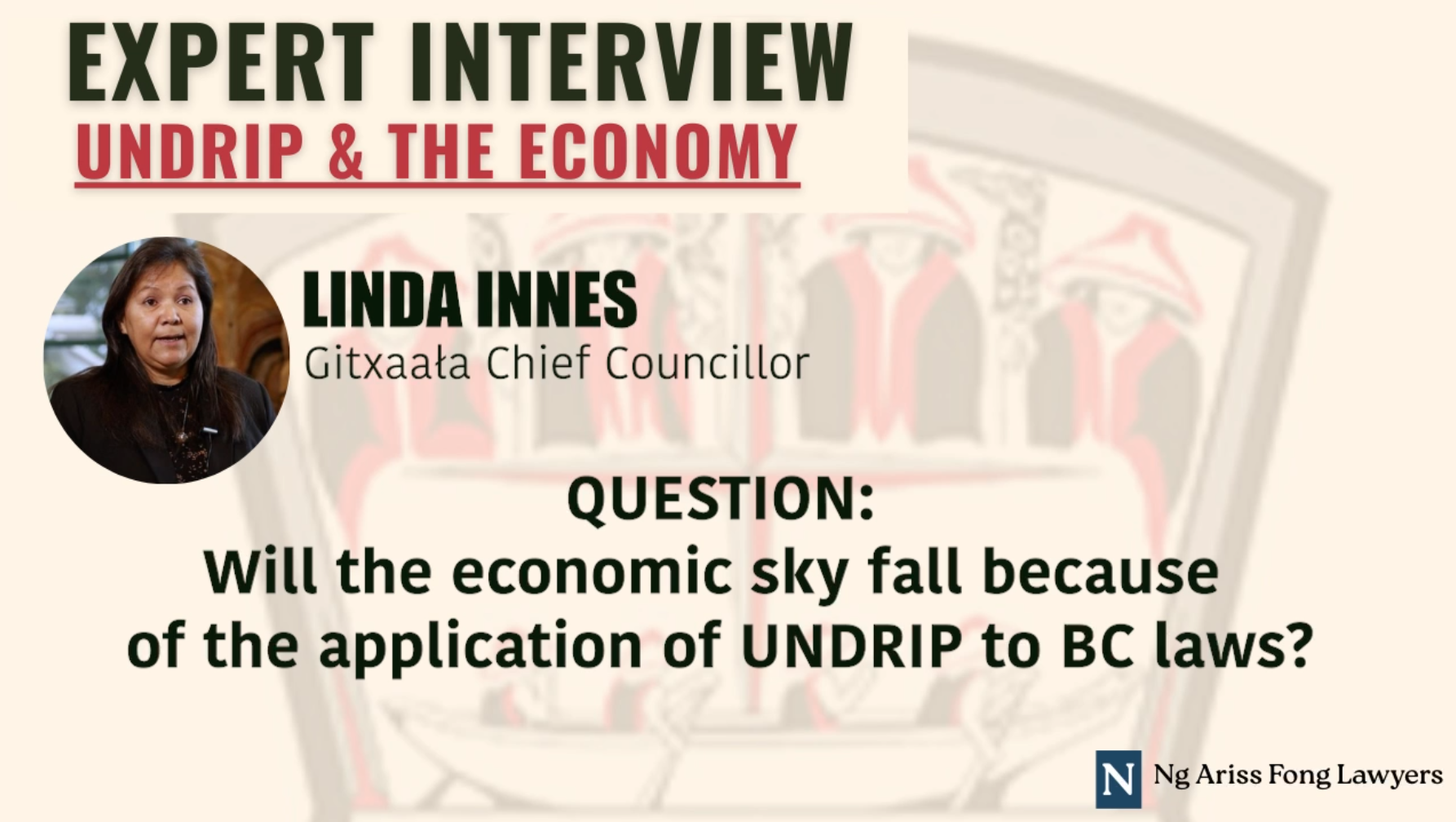
This blog series co-published by Ng Ariss Fong, Lawyers and West Coast Environmental Law features interviews with leaders and experts discussing the UN Declaration on the Rights of Indigenous Peoples (UNDRIP) and its relationship to the economy in BC and Canada.
Respecting Indigenous rights brings economic benefits
Gitxaała Nation Chief Councillor Linda Innes has a lot to say about how implementing the UN Declaration on the Rights of Indigenous Peoples (UNDRIP) – and BC’s Declaration on the Rights of Indigenous Peoples Act (Declaration Act or DRIPA) – can strengthen the economy.
Gitxaała employs hundreds of people in Prince Rupert and is one of the top commercial taxpayers, contributing greatly to the local economy on the north BC coast. These are the long-term, sustained economies that we need to build throughout British Columbia, in partnership with Indigenous peoples.
The team at Ng Ariss Fong, Lawyers sat down with Chief Councillor Innes to discuss some of the economic benefits and prosperity that can flow from collaboration and respect for Indigenous rights.
Key takeaways:
- The economic sky is not falling because of the Declaration Act – rather, it has the potential to boost economic activity and partnerships.
- First Nations like Gitxaała are making significant contributions to BC’s economy through their own businesses and support for projects in their territories.
- True economic solutions require partnerships, shared authority, and respect for Indigenous rights, not a retreat to the past.
- UNDRIP and the Declaration Act provide the framework for the certainty that’s needed to attract capital for economic projects in Canada.
Watch the video (transcript below):
Q: Will the economic sky fall because of the application of UNDRIP to BC laws?
A: I think that the claim that the economic sky will fall under UNDRIP or DRIPA [the Declaration Act] is not supported. Courts have affirmed that DRIPA is an interpretive framework that strengthens legal clarity, not chaos. And many First Nations are pro-development through leading their own projects or supporting other projects operating in their territories – Gitxaała is one of them.
UNDRIP provides a framework of certainty of how economic activities and Indigenous rights and title prosper together. So, quite the opposite – the sky is not falling.
UNDRIP provides the certainty necessary for Canada to attract capital investment and grow the GDP of the country. Gitxaała, we own many businesses within the city of Prince Rupert. We own the most iconic hotel in Prince Rupert, as well as the amazing Saltwater Bakery, Tyee Building Supplies, Gitxaała Forestry, and you know, this is Gitxaała’s investment into the Prince Rupert economy.
Gitxaała’s businesses directly employ more than 230 people in Prince Rupert, and we’re one of the top three commercial property taxpayers in the city. And, you know, so when you look at what folks have to say that the sky will fall because of the application of UNDRIP to our laws – the answer is no.
On the business opportunities arising from the operation of UNDRIP and DRIPA:
I think a wise economist would say that UNDRIP reduces the economic risk, lowers the conflict, strengthens long-term economic stability, and UNDRIP and DRIPA provide the missing framework to create economic certainty to attract capital projects in Canada.
For too many years, the lack of economic certainty has been attributed to Indigenous peoples. The courts have demonstrated time and time again that the lack of economic certainty is caused by the lack of common understanding of principled action. UNDRIP and DRIPA provide the framework for that certainty.
On proposed amendments to DRIPA and reconciliation:
Well, I don’t agree that DRIPA needs to be amended. DRIPA was co-developed with Indigenous nations, passed unanimously, with the understanding that it would guide government-to-government work. And any amendments to that shared framework require meaningful consultation with Indigenous people, because the Act itself commits the Province to working with us, not acting on us. Changing it without our participation would contradict the very principles DRIPA was built on.
The courts have clarified the Province’s obligation, they did not distort them. The legal framework is sound. The real work lies in implementing DRIPA faithfully, not diminishing it. Amending DRIPA risks creating more uncertainty, not less.
So I believe if we try to solve reconciliation challenges by returning to old colonial tools, top-down amendments, unilateral changes or limiting the courts, we will only reinforce the very systems that caused the problems. DRIPA was meant to move us beyond that. And true solutions require partnerships, shared authority, and respect for Indigenous rights, not a retreat to the past.
I have faith that Premier Eby understands that, political messaging aside, an amendment to DRIPA will not solve the problems. It’s just a delay – it delays the obvious and inevitable solutions. And together we can advance a collaborative framework where First Nations, BC and investors can look at a bright economic future, and future generations can prosper from the building blocks created today.
So strong relationships do not mean we will always agree, but great trust and respect for each other means we can set aside our differences and build a future together.
UNDRIP and the Economy Series:
- How does respect for Indigenous rights relate to the economy? Feat. Tahltan Elder Allen Edzerza
- Will the economic sky fall? Feat. Gitxaała Chief Councillor Linda Innes
- More to come...